
Panel
This article is part of a series covering the Fabian New Year Conference , written by Dave Baldock and Sue Watson
Thangam Debonnaire MP, Shadow Secretary of State for Digital, Culture, Media, and Sport
Armando Iannucci, Satirist and Writer
Tom Gray, PPC for Brighton Pavilion
Alison Cole, Director of Fabian Society Arts and Creative Industries Policy Unit
Chair: Charlotte Higgins, Chief Culture Writer at The Guardian
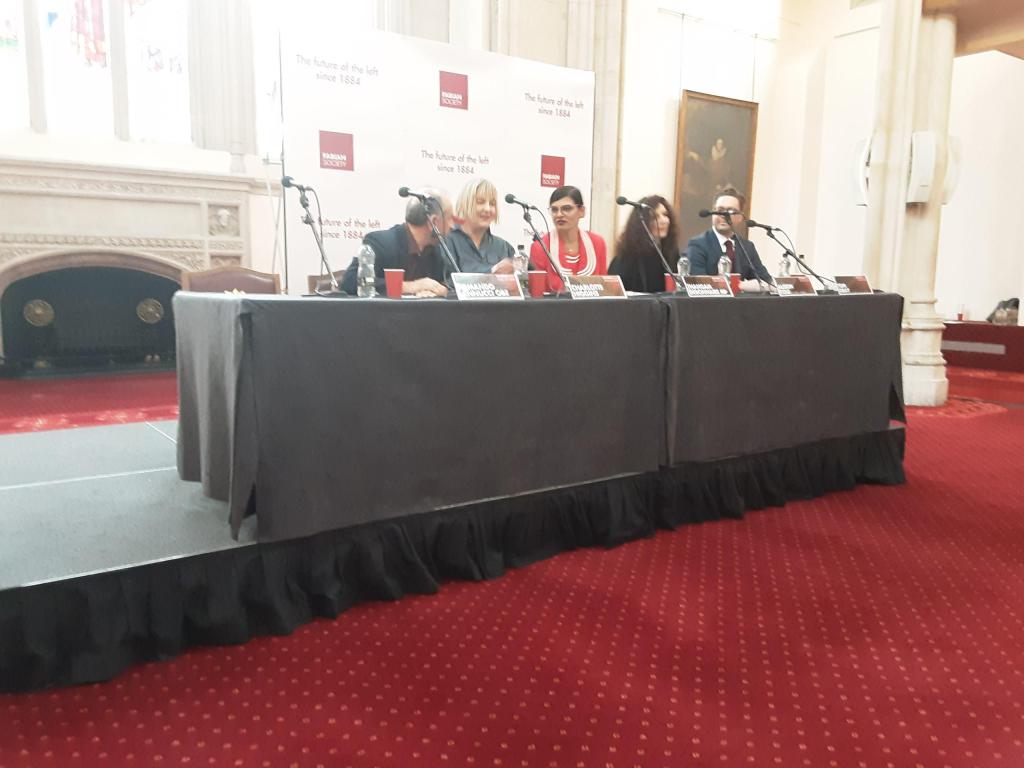
Thangam opened the panel discussion. The National Lottery had had a very positive effect in providing funding for the arts. There were new arts facilities throughout the country, generating a pride in both those establishments themselves and in the events that have been put on. This was all round a good thing.
The advent of austerity in 2010 reduced the level of government support for the arts and culture. Further reductions have resulted from the cutbacks in local authority budgets. More recently, the combined impact of COVID, inflation and Brexit have all helped to remove funds from the sector because of which many parts of it are struggling for survival.
Thangam believed storytelling is important in establishing a narrative of how to proceed. Under the Attlee Government, Jenny Lee had produced a White Paper on policy in the arts. This placed arts at the centre of policy making, and not remote from the population. Such an approach is still relevant and follows on from the creation of the Arts Council by the Labour government in 1946. Her approach to the Open University in 1969 followed a similar approach.
Where we are now is similar to the incoming problems facing the Labour government in 1964. The arts are under attack and has not been viewed seriously. There have been twelve Secretaries of State over the past Fourteen years. The Arts Council faced a reduction of a quarter of its funding in the period between the 2010 and 2015 elections. The reduction to the budget without thinking about the consequences has led to severe problems for the sector and has had a damaging effect on the Country.
.
Harold Wilson had been the first Prime Minister to have a Minister for the Arts and that was Jenny Lee. Lee had begun establishing the essential infrastructure that is a component of making sure that art the arts operate properly. The arts are for everyone they are important and all should be able to share in them.
It is important to value the whole ecosystem and do not want divergence between various parts of the industries based on their perceived inherent superiority.
Addressing the issues relating to arts and culture is integral part of the economic growth process. The sector is so large (see Armando Iannucci comments below) it is important economically[1].
If art becomes regarded as elitist, then its i’s being presented correctly.
The European Community still matters. One of the initial impacts was to make life difficult for UK musicians to work in Europe. The importance of having remuneration in place for artists and royalties on a common basis across Europe is an issue that needs addressing.
Cultural Education is important for the opportunities it creates for self-enrichment and subsequent employment.
Diversity and inclusion matter as they make for better art, more perspectives and draw on everyone’s talents. Arts and Culture therefore have a key role in national renewal.
There are sources of funding available to the arts that do not necessarily come from direct government subsidy Thangam was of the view that these should be explored to the full and that there were many private sector organisations willing to provide funding if they knew there was some coherence towards overall government policy in this area.
For example, the Film Tax Credit has led to many films being made in the United Kingdom.
Armando Iannucci spoke next. Arts has become increasingly relevant economically as the creative industries make up 6% of GDP worth £115 billion with around two million employees so the area needs to be treated with respect[2].
For example, the relocation of the English National Opera to Manchester was done as a cost cutting exercise and did not look at the needs of Manchester and London as regarding opera in general. The move was a mean decision done purely to save costs and, in the end, may result in the decimation of a part of an important sector of the industry, which as a result regards such moves as being treated with contempt. For example, Angela Rayner had been subject to much adverse comment from the right-wing press for going to Glyndebourne- why shouldn’t she?
Alison Cole spoke next and pointed out the scope for a cross departmental approach towards arts and culture making them part of Labour’s five missions. The arts belong to everybody and are central to education. in particular primary education we should include arts that are more than painting and drawing.
Two other areas to consider where there could be more additional funding this include the lottery tax relief another under used funding pots for example the unspent element of the levelling up fund.
Creative education is a supply side issue with a number of novel things can be done for example pairing together schools and arts organisation and creating the links between the two. Providing arts as part of breakfast club provision is another potential area of activity.
Arts is important and the Tories know that- arts are very well funded within the public-school sector.
Tom Grey spoke last, there is a tension within the commercial market for music and the need to ensure that musicians are paid a reasonable amount. Britain has an established sector that generate generates significant funds from the international market. At present, the Royalty regime is making this increasingly difficult as the regulations needed to deal with this are out of date with the new way in which people tend to consume music (streaming as opposed to physically purchasing something with the music on) which most of the regulations that are currently in place relate to
As well as commercial aspects to music it is good for health, good for mental health and has been shown to be particularly useful for people with dementia in keeping them involved with their families that bit longer.
The music industry has been a vehicle for social mobility. For this to remain the case, musicians need to be able to have an income in enables them to subsist and should not be seen as a cheap option. When people use musicians for events, they need to be paid rather than to be expected to work at sub market pay levels.
Eventually there will be a need for a National Strategy for Music
Although this will not be the number one priority for Labour when elected, it is one of those things that within the Arts and Culture department may well come to the fore later.
Another suggestion would be a United Kingdom music export office to assist. As Thangam had mentioned, there are issues with musicians getting visas necessary to work abroad as part of the Brexit settlement.
A copyright framework is required that enables musicians to be able to market and sell their talent in a way that provides some rewards. At present this is something that is a problem.
The United Kingdom understands music and culture and acts accordingly. It would be a safer place to live creating a creative pathway for children and being able to sustain them to work as musicians on an ongoing basis.
Questions from the audience began with a plea from the museum sector for more funding. The current funding was inadequate to maintain the level of activity at its current level with buildings in decay and the necessary requirement to maintain the exhibits also under pressure.
Section 114 notices[3] within Local Authorities are adding to this. As more resources are removed from local authorities, they are no longer able to fund the museum sector to the same level, but they were able to do in the past.
There was a plea for a National Museum strategy and a need for funding now to deal with some of the emergency problems. This is one of those things to add to the list of things that Labour would like to spend money on and will need to consider which of these is a priority in due course.
Thangam responded that she appreciated they are looking for funding. There may be other platforms than directly from government or indirectly by local government where they will be able to obtain more funding. This could mean looking at the private sector, the lottery and or philanthropy as being part of the answer. Not necessarily ideal given the current economic climate, but this may be a way of providing additional resources.
The next question was about the BBC licence fee and what the Labour Party would be doing with this. Thangam did not provide an answer but did indicate that there was some consideration being given to Labour would do. while noting that in all probability the Conservatives will have already moved a long way down the path, if not decided what the future of the licence fee is before we get to the election- in which case for Labour the alternative their perspectives would be different.
The intention was to have an interim review of the BBC. Universality is the key, and the intention would be to not deny anyone access. This is a probably an indication that the BBC would not be moving to a subscription service anytime soon under Labour Government.
The BBC’s future would be part of a briefing due from the civil servants in the next week or so after which Thangam may be able to provide an update.
One of the suggestions was to broaden the 1964 Library Act to all elements of the art so as with libraries there is an entitlement to library provision, this is extended towards an entitlement to cultural activity. Obviously, this would need thinking about and no firm commitment to enter such a proposal was made/
The point that was made earlier was made again, that the potential for funding from the private sector exists, particularly when the private sector comes to the view that the Government has a strategy and a purpose and an overall idea of what it wants to do with the sector and therefore any money invested by the private sector won’t be into projects that are not sustainable.
One of the proposals that could be considered is to have public art in every building.
The Copyright Act of 1988 has only been changed once that was in 2001 to deal with downloading. The act does not deal with streaming and work on the on a European copyright regime is underway. This is essential if the sector is to continue to be viable.
The European regime is more advanced than the American regime although the two clearly into have an overlap and need to have some sort of alignment, Currently the European regime is not in UK legislation although people including Carole Tongue are working on this.
Thangam is live to both the potential and the challenges of Artificial Intelligence (AI), and it is important to view the two together because there are positive aspects from what AI can bring to the table as well as some of the risks to the artists themselves.
Ultimately recognising and rewarding the artist through the copyright regime is the way forward. It is important not to rely on lower end terms and conditions for artists and there should not be an expectation that people will provide art of any form for free.
An interesting session covering the whole range of arts and cultural matters from copyrights, BBC and the reason why arts itself is important. Funding does not to come from central government.
This aligned with the central theme of the day. A Labour government needs to establish a better mood in the country where people are more content with their lives, something that has gone astray under the current regime.
This is not going to be easy to do, particularly as resources are limited and priorities will need to be established/
This was a theme that came through each of the theme groups; that there are whole host of things that Labour wants to do but they cannot all be done at once. Some may need a second or third term before they can be brought to the table.
Not a particularly exciting prospect and will be a hard sell so it is important generally that there is something on the table within the manifesto that will improve the look and feel of people’s lives quickly after the election.
As to what this might be many could speculate very few know what the intention is that will become clearer as the manifesto Is produced.
DB
[1] Arts Council England, Arts contribution to the economy https://www.artscouncil.org.uk/research-and-data/contribution-arts-and-culture-industry-uk-economy
[2] As reference above
[3] Notices issued by Council Chief Finance officers when Councils are unable to meet ongoing obligations within existing resources,
 Havering Fabian Society