This article is part of a series covering the Fabian New Year Conference , written by Dave Baldock and Sue Watson
Opening Comments
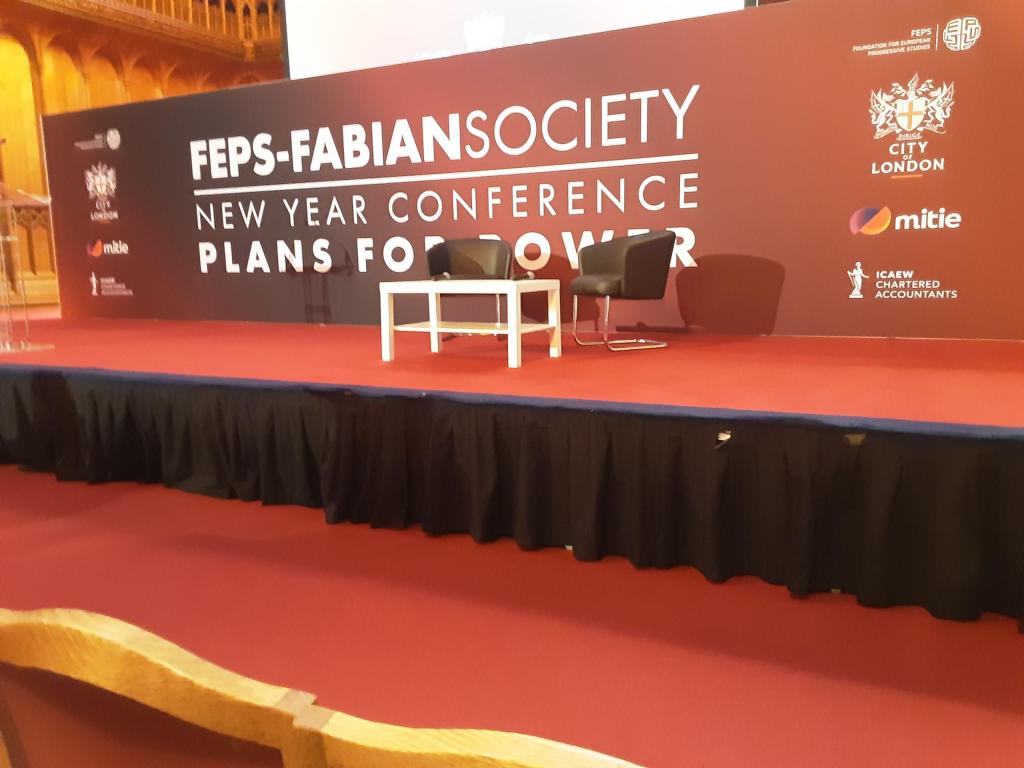
The event, held in The Guildhall, was opened by the General Secretary of the Fabians, Andrew Harrop. He informed the meeting it was the 140th year of the Fabians and gave an overview of the significant input to policies and politics the organization has had. He ended his opening comments by looking for a Labour government to win the 2024 election for the good of the country.
He was followed by a representative from the City of London Corporation. He spoke of the history of Labour. An example of how the Fabians have worked with and impacted on Labour policy was, thirty years ago the Fabians proposed making the Bank of England independent. Gordon Brown introduced this idea.
Then what is needed, he outlined three key areas with the importance of each touched on.
Economic growth/business growth
Financial and professional services
Government, businesses and the third sector are working together to solve problems both nationally and internationally.
The Fabians chair then introduced the first Keynote speaker and looked to welcoming in a Fabiantastic Labour government.
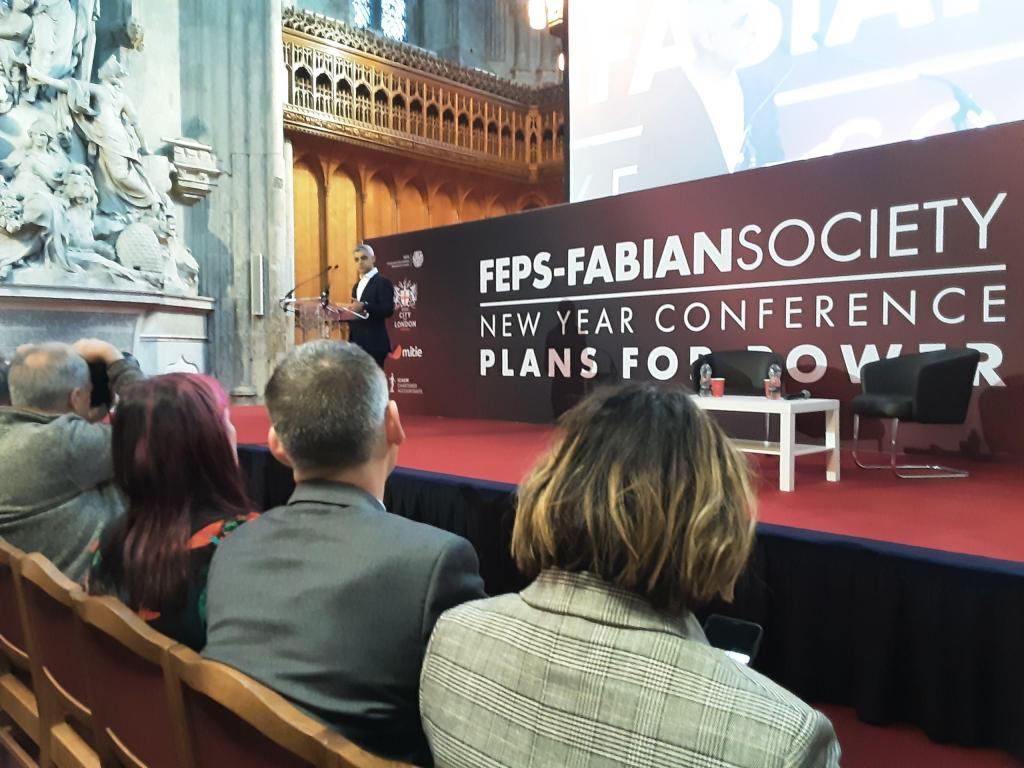
Keynote Speaker- Mayor of London Sadiq Khan
Sadiq opened his address by wishing the Fabians a happy 140th birthday and that he is looking for City Hall, the Government and the Great Offices of power all held by Labour and the think tank that is the Fabians. He said imagine what a Labour mayor working with a Labour government could achieve for London and the whole country.
He then expanded on his overall theme of universalism. Sadiq sees this as defining society through the values held by that society. Values would be similar, and all would work together for the good of the society they are part of. This includes elements such as a living wage, secure livelihoods for all and how older and disabled members of the society are enabled.
A further example of universalism championed by early Fabians, was the concept of good nutrition for all children and the positive impact that has. The continuation of the free school meals for all Primary aged children was shared with the meeting. Sadiq commented that education is the great leveler.
Sadiq was clear that economic competency will lead to social justice. With ULEZ he sees this as a green issue, a racial and social justice issue as well as leading to health improvement, particularly for children.
Re Brexit he ran through some of the economic costs to London, the cultural, educational and social costs. There is also a skill and labour shortage. Sadiq gave the figure of approximately £30billion as the cost to the economy of London. He stated a closer relationship with the European Union, as per David Lammy’s stance, would work to reduce the impact.
He shared that there is a rise in crime and anti-social behaviors, highlighting the feelings this gives rise to. However, he linked this to the loss of youth clubs/facilities, youth workers and cuts to the police. Sadiq acknowledged the work Yvette Cooper is undertaking working with communities to bring about progress.
He also touched on the Gaza/Palestinian/Israel situation. Sadiq was clear that a ceasefire is needed, Netanyahu is “roadblock to peace” and a two-state solution could provide the peace and stability the region needs.
Sadiq closed his speech by saying politicians either play on people’s fears or listen and addresses those fears. He reiterated imagine what a Labour Mayor working with a Labour Government could achieve, stating Britain is at its best when Labour is at its best.
This article is part of a series covering the Fabian New Year Conference , written by Dave Baldock and Sue Watson
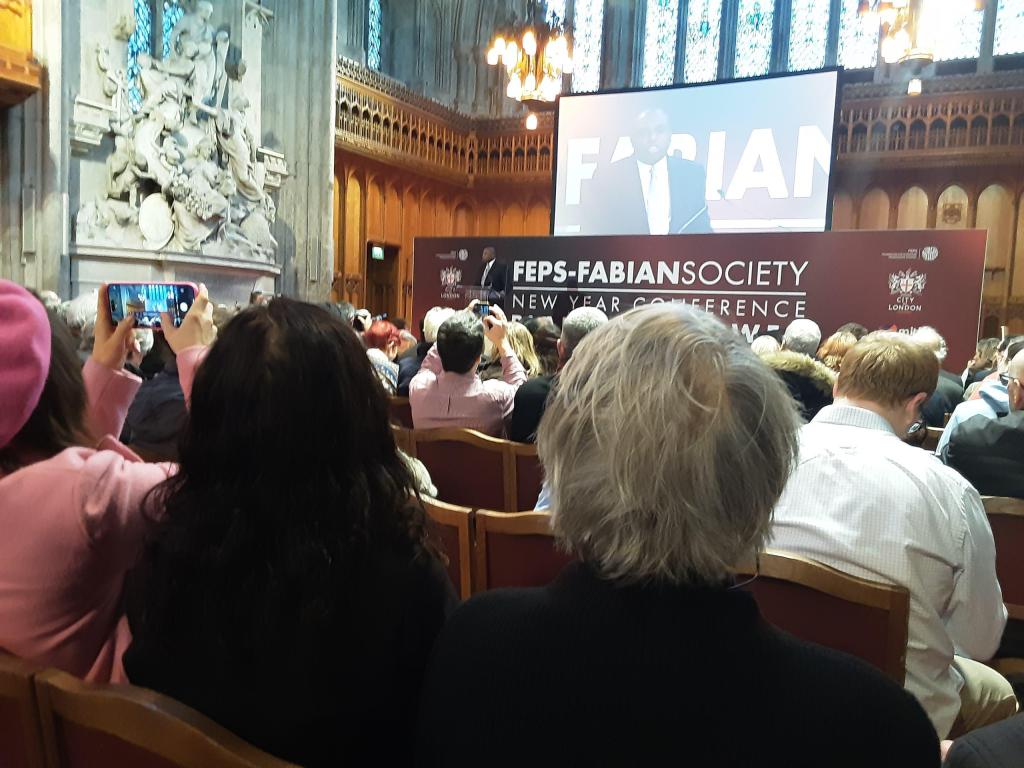
David started by thanking the Fabian Society for the invitation. During the speech he was interrupted several times by protestors over the Labour approach to the war Gaza and Israel’s aggression. The disruption attracted coverage in the national media.
The General Election gave the Country a change option between Labour and the Conservatives. Labour offered green jobs and protection for the planet.
The Government was proposing to break international law with the Rwanda scheme. The rule of law is fundamental and doing this sets a dangerous precedent.
Labour would reconnect and restore the UK’s influence in the world. There were bleak issues to deal with – Ukraine and Gaza were worrying but there is a rising threat of military power and neglect of Human Rights
The older rules-based order is eroding with great power rivalry causing tension. Institutions such as the United Nations are not valued, and with the climate in crisis the influence of government is being reigned back. Mounting disorder does not help address climate issues as there is a lack of co-ordination.at Government level.
After the first interruption, David resumed.
Labour wants a sustainable cease fire in Gaza.
Change will be brought about by Labour in power not by protest. Labour in government will have more ability to achieve this.
David Lammy’s recent Fabian pamphlet sets out a vision reconnecting Britain to the world[1].
This advocated “progressive realism” – equality, rule of law, internationalism.
We must deal with the world as it is, not as we would wish it to be. This continues the realism of Bevin, the architect of NATO, and the principled foreign policy advocated by Robin Cook.
Bevin saw things as they were. He was not a fan of Stalin and would not be a fan of Putin. He advocated the nuclear deterrent and standing up to dictators. He had faults, particularly views on the empire.
Robin Cook had conviction and principles. The response of the Labour government to Kosova reflected this.
Labour needs to operate in the real world of Bevin and apply the idealism of Cook.
The new world disorder is changing lives with more conflicts. Gaza had seen thousands of innocent people killed. Eighty-five per cent of the population were refugees, and there were still over a hundred hostages.
The position was intolerable, and Lammy called for a sustainable cease fire. He had been to the Middle East four time, and each time there was a fear of escalation. Israel and Hizballah were close to conflict. The conflict had expanded to the Red Sea which was threatening food prices. So, closing the Red Sea would have significant CONSEQUENCES.
Preventative diplomacy is needed, one of Britain’s strengths. In its approach to Israel and Palestine the UK had seen a decade of indifference. It is important not to sleepwalk in to despair.
The Israeli PM was morally wrong to reject a Palestinian state. Israel must change. Under a Labour government the UK will collaborate with partners to recognise Palestine as part of a move to peace,
Russia has chosen war in Ukraine and was now aligned with Iran and North Korea.
Soth Korea had provided more shells to Ukraine than Europe. There needs to be a long-term response and a pathway to Ukraine NATO membership.
This is progressive realism.
The climate is a longer-term issue. The COP approach has made progress, albeit too slowly. We should not lose perspective After Paris 2015, the rise in temperature was forecast to rise by 3.5 degrees, now the projection is 2 degrees. So, progress has been made. The expenditure on clean energy id now doubles that on fossil fuels.
The UK can set an example. Labour is committed to ending new licences in the North Sea. There is a need to build on “securenomics” to build and protect green markets.
We are living through a crisis and if and when Labour returns to Government the eyes of the world will be on us.
The aim of Government is to keep people secure, and the planet protected. Neither is guaranteed and Labour needs to rise to the challenge.
This article is part of a series covering the Fabian New Year Conference , written by Dave Baldock and Sue Watson
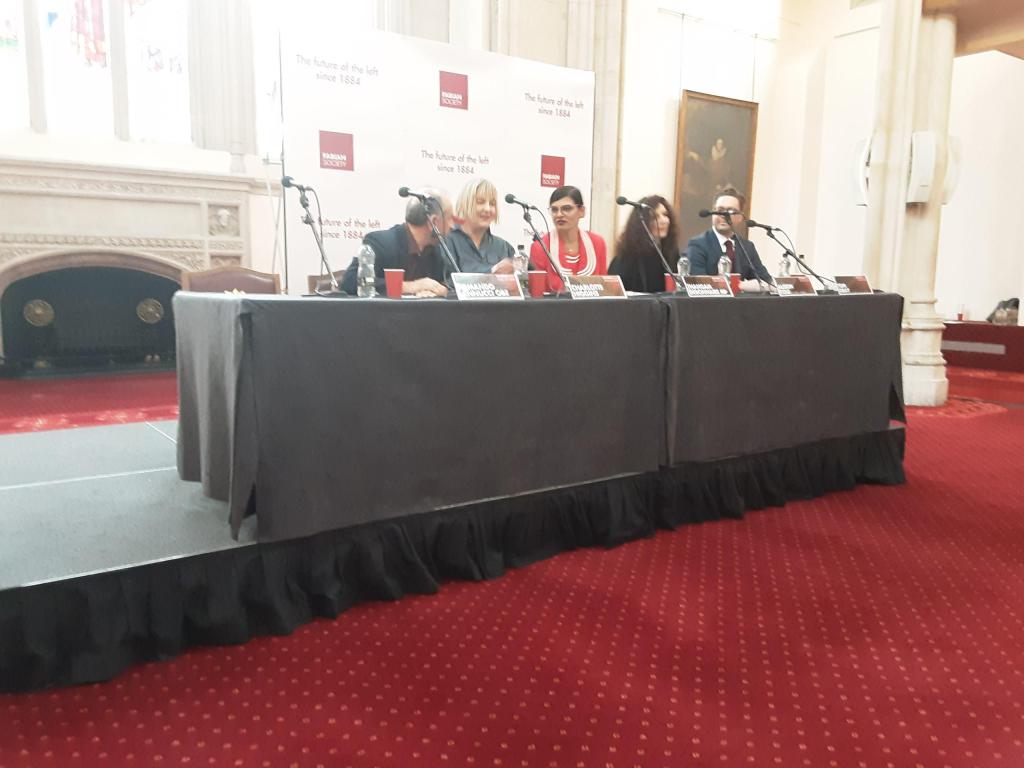
Thangam Debonnaire MP, Shadow Secretary of State for Digital, Culture, Media, and Sport
Armando Iannucci, Satirist and Writer
Tom Gray, PPC for Brighton Pavilion
Alison Cole, Director of Fabian Society Arts and Creative Industries Policy Unit
Chair: Charlotte Higgins, Chief Culture Writer at The Guardian
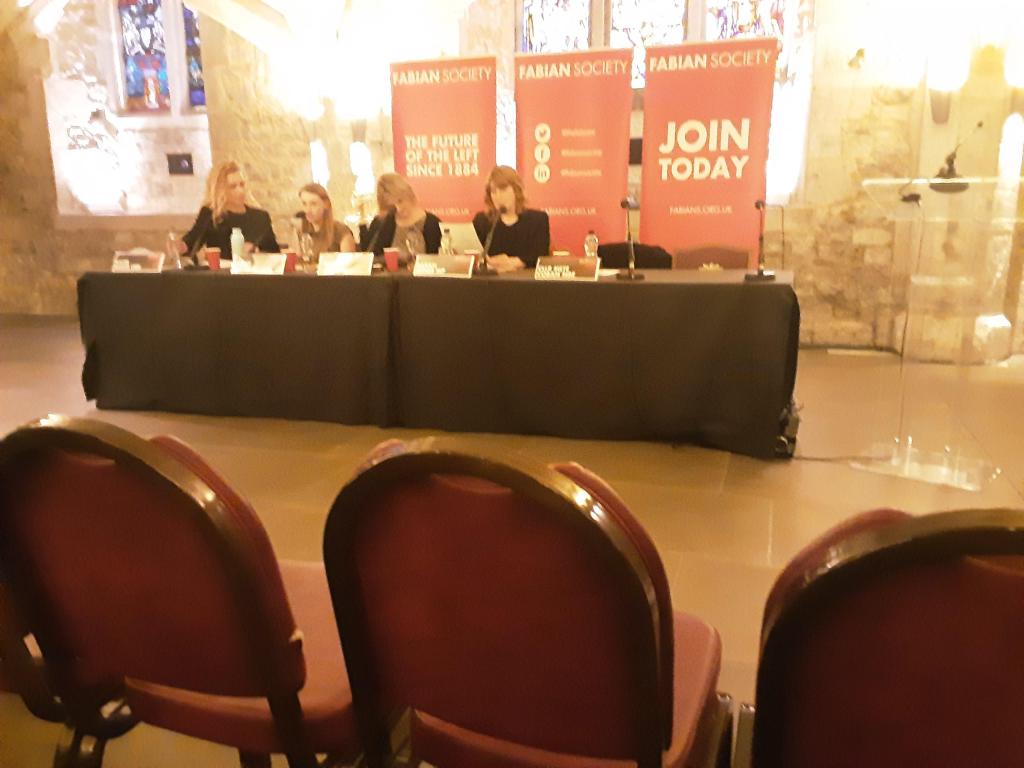
Thangam opened the panel discussion. The National Lottery had had a very positive effect in providing funding for the arts. There were new arts facilities throughout the country, generating a pride in both those establishments themselves and in the events that have been put on. This was all round a good thing.
The advent of austerity in 2010 reduced the level of government support for the arts and culture. Further reductions have resulted from the cutbacks in local authority budgets. More recently, the combined impact of COVID, inflation and Brexit have all helped to remove funds from the sector because of which many parts of it are struggling for survival.
Thangam believed storytelling is important in establishing a narrative of how to proceed. Under the Attlee Government, Jenny Lee had produced a White Paper on policy in the arts. This placed arts at the centre of policy making, and not remote from the population. Such an approach is still relevant and follows on from the creation of the Arts Council by the Labour government in 1946. Her approach to the Open University in 1969 followed a similar approach.
Where we are now is similar to the incoming problems facing the Labour government in 1964. The arts are under attack and has not been viewed seriously. There have been twelve Secretaries of State over the past Fourteen years. The Arts Council faced a reduction of a quarter of its funding in the period between the 2010 and 2015 elections. The reduction to the budget without thinking about the consequences has led to severe problems for the sector and has had a damaging effect on the Country.
.
Harold Wilson had been the first Prime Minister to have a Minister for the Arts and that was Jenny Lee. Lee had begun establishing the essential infrastructure that is a component of making sure that art the arts operate properly. The arts are for everyone they are important and all should be able to share in them.
It is important to value the whole ecosystem and do not want divergence between various parts of the industries based on their perceived inherent superiority.
Addressing the issues relating to arts and culture is integral part of the economic growth process. The sector is so large (see Armando Iannucci comments below) it is important economically[1].
If art becomes regarded as elitist, then its i’s being presented correctly.
The European Community still matters. One of the initial impacts was to make life difficult for UK musicians to work in Europe. The importance of having remuneration in place for artists and royalties on a common basis across Europe is an issue that needs addressing.
Cultural Education is important for the opportunities it creates for self-enrichment and subsequent employment.
Diversity and inclusion matter as they make for better art, more perspectives and draw on everyone’s talents. Arts and Culture therefore have a key role in national renewal.
There are sources of funding available to the arts that do not necessarily come from direct government subsidy Thangam was of the view that these should be explored to the full and that there were many private sector organisations willing to provide funding if they knew there was some coherence towards overall government policy in this area.
For example, the Film Tax Credit has led to many films being made in the United Kingdom.
Armando Iannucci spoke next. Arts has become increasingly relevant economically as the creative industries make up 6% of GDP worth £115 billion with around two million employees so the area needs to be treated with respect[2].
For example, the relocation of the English National Opera to Manchester was done as a cost cutting exercise and did not look at the needs of Manchester and London as regarding opera in general. The move was a mean decision done purely to save costs and, in the end, may result in the decimation of a part of an important sector of the industry, which as a result regards such moves as being treated with contempt. For example, Angela Rayner had been subject to much adverse comment from the right-wing press for going to Glyndebourne- why shouldn’t she?
Alison Cole spoke next and pointed out the scope for a cross departmental approach towards arts and culture making them part of Labour’s five missions. The arts belong to everybody and are central to education. in particular primary education we should include arts that are more than painting and drawing.
Two other areas to consider where there could be more additional funding this include the lottery tax relief another under used funding pots for example the unspent element of the levelling up fund.
Creative education is a supply side issue with a number of novel things can be done for example pairing together schools and arts organisation and creating the links between the two. Providing arts as part of breakfast club provision is another potential area of activity.
Arts is important and the Tories know that- arts are very well funded within the public-school sector.
Tom Grey spoke last, there is a tension within the commercial market for music and the need to ensure that musicians are paid a reasonable amount. Britain has an established sector that generate generates significant funds from the international market. At present, the Royalty regime is making this increasingly difficult as the regulations needed to deal with this are out of date with the new way in which people tend to consume music (streaming as opposed to physically purchasing something with the music on) which most of the regulations that are currently in place relate to
As well as commercial aspects to music it is good for health, good for mental health and has been shown to be particularly useful for people with dementia in keeping them involved with their families that bit longer.
The music industry has been a vehicle for social mobility. For this to remain the case, musicians need to be able to have an income in enables them to subsist and should not be seen as a cheap option. When people use musicians for events, they need to be paid rather than to be expected to work at sub market pay levels.
Eventually there will be a need for a National Strategy for Music
Although this will not be the number one priority for Labour when elected, it is one of those things that within the Arts and Culture department may well come to the fore later.
Another suggestion would be a United Kingdom music export office to assist. As Thangam had mentioned, there are issues with musicians getting visas necessary to work abroad as part of the Brexit settlement.
A copyright framework is required that enables musicians to be able to market and sell their talent in a way that provides some rewards. At present this is something that is a problem.
The United Kingdom understands music and culture and acts accordingly. It would be a safer place to live creating a creative pathway for children and being able to sustain them to work as musicians on an ongoing basis.
Questions from the audience began with a plea from the museum sector for more funding. The current funding was inadequate to maintain the level of activity at its current level with buildings in decay and the necessary requirement to maintain the exhibits also under pressure.
Section 114 notices[3] within Local Authorities are adding to this. As more resources are removed from local authorities, they are no longer able to fund the museum sector to the same level, but they were able to do in the past.
There was a plea for a National Museum strategy and a need for funding now to deal with some of the emergency problems. This is one of those things to add to the list of things that Labour would like to spend money on and will need to consider which of these is a priority in due course.
Thangam responded that she appreciated they are looking for funding. There may be other platforms than directly from government or indirectly by local government where they will be able to obtain more funding. This could mean looking at the private sector, the lottery and or philanthropy as being part of the answer. Not necessarily ideal given the current economic climate, but this may be a way of providing additional resources.
The next question was about the BBC licence fee and what the Labour Party would be doing with this. Thangam did not provide an answer but did indicate that there was some consideration being given to Labour would do. while noting that in all probability the Conservatives will have already moved a long way down the path, if not decided what the future of the licence fee is before we get to the election- in which case for Labour the alternative their perspectives would be different.
The intention was to have an interim review of the BBC. Universality is the key, and the intention would be to not deny anyone access. This is a probably an indication that the BBC would not be moving to a subscription service anytime soon under Labour Government.
The BBC’s future would be part of a briefing due from the civil servants in the next week or so after which Thangam may be able to provide an update.
One of the suggestions was to broaden the 1964 Library Act to all elements of the art so as with libraries there is an entitlement to library provision, this is extended towards an entitlement to cultural activity. Obviously, this would need thinking about and no firm commitment to enter such a proposal was made/
The point that was made earlier was made again, that the potential for funding from the private sector exists, particularly when the private sector comes to the view that the Government has a strategy and a purpose and an overall idea of what it wants to do with the sector and therefore any money invested by the private sector won’t be into projects that are not sustainable.
One of the proposals that could be considered is to have public art in every building.
The Copyright Act of 1988 has only been changed once that was in 2001 to deal with downloading. The act does not deal with streaming and work on the on a European copyright regime is underway. This is essential if the sector is to continue to be viable.
The European regime is more advanced than the American regime although the two clearly into have an overlap and need to have some sort of alignment, Currently the European regime is not in UK legislation although people including Carole Tongue are working on this.
Thangam is live to both the potential and the challenges of Artificial Intelligence (AI), and it is important to view the two together because there are positive aspects from what AI can bring to the table as well as some of the risks to the artists themselves.
Ultimately recognising and rewarding the artist through the copyright regime is the way forward. It is important not to rely on lower end terms and conditions for artists and there should not be an expectation that people will provide art of any form for free.
An interesting session covering the whole range of arts and cultural matters from copyrights, BBC and the reason why arts itself is important. Funding does not to come from central government.
This aligned with the central theme of the day. A Labour government needs to establish a better mood in the country where people are more content with their lives, something that has gone astray under the current regime.
This is not going to be easy to do, particularly as resources are limited and priorities will need to be established/
This was a theme that came through each of the theme groups; that there are whole host of things that Labour wants to do but they cannot all be done at once. Some may need a second or third term before they can be brought to the table.
Not a particularly exciting prospect and will be a hard sell so it is important generally that there is something on the table within the manifesto that will improve the look and feel of people’s lives quickly after the election.
As to what this might be many could speculate very few know what the intention is that will become clearer as the manifesto Is produced.
This article is part of a series covering the Fabian New Year Conference , written by Dave Baldock and Sue Watson
Panel
Liam Byrne MP
Caroline Abrahams CBE, Charity Director at AGE UK
Abby Jitendra, Principal Policy Adviser at Joseph Rowntree Foundation
Sasjkia Otto, Senior Researcher at the Fabian Society
Chair: Clare McNeil, Associate Fellow at IPP
Liam Byrne spoke first. Britain had increasing levels of poverty and work was no longer a route out. His new book addressed some of the issues this raised.[1]
Seventy per cent of the wealth of the Country was in the hands of one per cent of the population.
Since 2010 inequality had grown with thirty-one times more being held by the top 1%. Sale of luxury goods is at an all time high, while life expectancy is in decline.
Unequal nations are unhappy, and this was true of Great Britain. Inequality drives corruption (for example PPE during covid).
The position will only improve if we do something. As rich baby boomers die, their wealth will pass on to their families. Others will face large care bills. This will accelerate the wealth differential. The underlying issues were set out clearly ten years ago by the French economist Thomas Pickety in his book “Capital.”[2] Not a lot had changed since publication.
Having set out the problems here are some solutions.
Smarter growth – devolution is part of this so regions and Councils can take decisions that will work for their area.
Stop the race to the bottom – there may need to be a second big bang in the city. If so, pension savers have muscle to influence this. The 32,000 pension funds can exert influence but do not use this,
Universal Basic capital – provide a lump sum to all 18 years olds to change their life prospects.
Savings accounts for the young
Auto enrolment in pension schemes for long term income
This could be funded via a Sovereign Wealth Fund which will take time to build, so is a longer-term solution.
Restore fairness to the tax system – there is investment income of £80 billion which if taxed differently could raise significant amounts.
These are ideas which have been tried elsewhere in the world and have worked.
On a happier note, ninety per cent of all scientists that have ever worked are alive today, so there is scope to be optimistic about innovations and the difference that these can make.
Assets and Wealth are important for life chances.
There are 2,6 million people who are off work as long-term sick, an all-time high.
Of these £1.5milion are on a waiting list. The health service has lost 150,000 health care workers since the pandemic, so is not a position to improve the situation. Getting the Health service right will have influence on this.
A recent Fabian paper[3] makes recommendations on this including.
Employment Rights from day one of employment
Carers and disability leave.
A national occupational health service
Create a duty to look at where employers fall short?
There is a hostile environment toward those on universal credit and we need to dismantle this.
We also need to address the issues facing those coming up to retirement who are made unemployed between 55-65. If people have financial issues in this age group there are limited opportunities to correct the position. Universal credit draws on savings at a time in life when people could have been saving for retirement.
. Universal Criedit would consider savings between £6.000 and £16,000 which would impact significantly on this heading for retirement. Savings above £16,000 could be eroded or wiped out by an extended period of unemployment, which would impoverish people before they reach retirement age,
Older people vary in wealth, some are okay others not. A third of those entitled to Pension Credit do not claim it.
One in five families are in poverty, which is six million people.
There has been a three time increase in the number of food parcels provided.
The Joseph Rowntree Trust has looked at why-
Costs are volatile.
Wages have not kept up.
Benefits are inadequate.
Without spending more the possibilities are
Looking at the profit levels in the care sector
Linking public funding to decent wages and salaries
Paid care leave
Essentials guarantee – match the cost of living (this will cost)
Economic growth will provide the funding for this so has to be the priority. It will take time to address all the issues.
The tax system is unfair, the income from wealth has doubled this century and tax income have not kept pace.
The tax rebate given to those with over £100k invested in ISAs is worth two billion pounds per annum. Is this fair and reasonable?
Questions were then taken from the audience.
How can we tax wealth when people work hard to “off shore” their wealth? The aim would be to address this although this needs handling with care to minimise avoidance,
The point was made that constant references by politicians to “working people” alienated people acting as full-time carers who were just as important.
Consideration could be given to levying National Insurance on investment income, so taxing it on the same basis as income from work.
Can we redistribute wealth to younger people?
Inheritance tax was important in addressing wealth accumulation. Could consider a “gift tax” so the receiver pays.
Child care has been expanding to enable parents to work but there were capacity issues. The government has started to address this. The sector is one of low pay which makes a career unattractive.
, There is scope for increasing responsibility of employers to ensure the health of their workforce e.g. care workers.
An increase in employment rights (particularly for the young) would be effective as would better pay and payment for travel time.
Some care chains generate significant profits while others do not, and many smaller companies struggle.
There is not enough money in the system to fund major improvements to terms and conditions, and increased inheritance tax could be used to address this. it would take time to achieve this,
Poverty is not a stand alone “mission” but cuts across Labour’s five missions. The missions aim to shift the narrative to “we” not “me” in national thinking, as we aim to produce a fairer society, one with a sense of hope.
DB
[1] The Inequality of Wealth: Why it Matters and How to Fix it. – Liam Byrne
This article is part of a series covering the Fabian New Year Conference , written by Dave Baldock and Sue Watson
PANEL
Sarah Jones MP, Shadow Minister for Industry and Decarbonisation
Katie White OBE, PPC for Leeds North West
Eloise Sacares, Researcher at the Fabian Society
Cllr Mete Coban MBE, Hackney Council, Cabinet Member for Energy, Waste, Transport and Public Realm.
Chair: Helena Horton, Environment reporter for the Guardian
Sarah Jones began the session with background to how Labour organised around this issue. At Shadow Cabinet level the oversight of this area was dealt with by John Reynolds (Industry) and Ed Miliband (decarbonisation)
Over the preceding days, the announcement had been made on the future of Port Talbot steel works, which would potentially see 3.000 jobs lost[1] as the result if two furnaces. Labour would not do this, and a key part of the Industrial Strategy was to retain steel making capacity. In part this would be due to security issues.
The Government was failing on climate change, to the extent that its internal critics had resigned to cause a by election (Chris Skidmore Kingswood). The crisis is deepening, and recent projections has suggested that the UK would face demand for water greater than supply in the 2050’s.
There were lots of ideas about what could be done and support from the relevant UK industries. Labour had the ambition to deliver these and looked to the Biden Administration in the USA for what could be done[2] with a more active state. It is important to consider Biden’s increased investment into this area had not resulted in a poll lead.
Labours aims in this area were.
Help communities to cope with the cost-of-living crisis – windfall taxes may help this.
Create Great British Energy – to ensure independence.
Create a National Wealth Fund – to reinvest in ports and infrastructure.
Upgrading the National Grid
Reform planning.
Reform the Apprentice Levy to increase support for technical colleges and similar institutions,
Insulation of drafty homes – a proposal that would create lots of jobs.
The was widespread disillusionment with politics on the doors and people were now listening to Labour. Labour needs to be believed if we are to get elected and deliver.
The next election would be the first where Climate change was seen by the electorate as a big issue.
Eloise Sacares has written a recent pamphlet for the Fabian Society on these issues [3]. Already the UK is having to cope with climate change, and it is vital we meet the net zero commitment. We are already seeing extreme weather including floods, heat, and drought. There had been a record number of deaths globally from these. There had already been six hundred flood warnings in the UK before the end of January.
The government has not adapted. Flood defences are weak, and this is an area we can address through a change in policy. There is scope for Labour to make a difference. It is low income and the most vulnerable people that suffer from flooding and overheating.
Should there be a maximum working temperature law, and tougher requirements for resilience from infrastructure suppliers.
Katie White has a climate change background and is PPC for Leeds North West. The science is clear, and the position is getting worse. What opportunities does this present?
Growth is central to Labour’s economic recovery plan and the green sector is important. The United Kingdom had a competitive advantage in 2010 but had lost three out of ten of the world’s top businesses in this area since,
Globally there is a big north \ south divide.
We need to identify what are the key industries in this area and locate new industries in the North to achieve some “levelling up.”
Aston Martin were now producing gear boxes for wind turbines. This type of change is a good example of how industries can adapt.
Mete Coban is a Hackney Councillor. Labour needs to focus on green jobs and lower energy prices. Need to consider how to engage with and encourage people. Hackney has a green zone with £61 million investment in to sustainable transport, and trees – 5.000 had been planted on the streets, 1,000 in parks.
Hackney has a community energy fund to encourage initiatives in schools, churches etc. There are lots of jobs in this area, but a skills gap that needs addressing.
The Council is looking to provide Electric Vehicle (EV) charging points. Local businesses are very engaged when the Council can give certainty on what will be done.
Younger people are interested in this, and it is important we do not betray them by not acting now.
It is good to have innovative ideas. For example, why not increase tax on SUVs and frequent flyers?
It is important to focus on outcomes and not the £28 billion figure that has dominated the Labour approach[4]. This would make the issue real for people and needs to be supported by a clear argument against the costs of not acting now.
More trees will help with Carbon dioxide absorption. Reversable heat pumps will enable cheaper cooling.
There were several interesting questions.
The young were not homogenous and while some were very engaged with climate issues, others were not. This applied to traditional politics as well.
Farming issues had not been addressed yet and need to be.
Fossil fuel lobbyists prevail at COP, and this is an issue.
Homes need to be built in the right place (not flood plains). Should all new homes have solar panels and full insulation?
An interesting session which reflects how fast the issues can change. The Port Talbot decision had just been announced. The move to remove two blast furnaces had environmental positives but would decimate employment in the area. There were options. The comment about needing outputs rather than a £28 billion figure proved all too accurate!
Ken will speak on “My days as a trade unionist in Fleet Street” which included the Wapping dispute.
Ken has been a Councillor in both Havering and Newham, where he was Deputy Mayor. He has a wealth of experience in Labour politics, having been London Regional Director
The meeting is om 24th June 8pm at Saffron House 273 South Street Romford RM1 2EZ
In the first of a series, Claire Blakemore sets out why art matters and the difference that positive engagement can have in educational, well-being, employment, and economic terms.
In the last few years, the ‘cost of living crisis’ is a phrase parroted by politicians so incessantly it has become thought paralysing. Often used as a self-evident explanation of why we must tighten the public purse, it is increasingly difficult to open up debate around public spending for fear of being seen as fiscally irresponsible. After all, we need to be grown up about it. There is simply no money to go around for nice little luxuries like reduced hospital waiting times or building new schools.
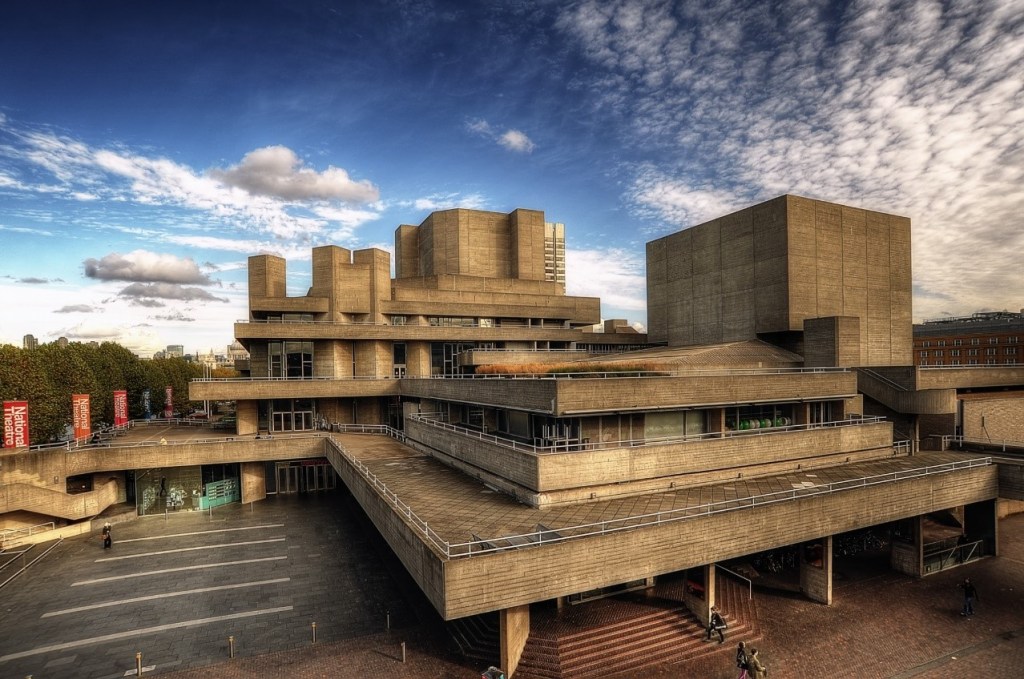
Figure 1 The National Theatre London
Not only this but the cost of living crisis is treated not as a man-made reality (however global and complex the cause), but instead an inexplicable, almost supernatural event that has befallen us. And now that this bone-rattling curse is here, we must accept our new normal. The stance taken by many Conservatives is that it is unnecessary to explore what the crisis means, and how we got here. For example, questions around why Britain is the only major Western economy in which inflation hit double digits or that the economy is predicted to experience the weakest growth in the G7 in 2024, are curiously few and far between. (1)
None of this is to say that there is not a crisis. People are facing extremely difficult choices. The Trussell Trust, an anti-poverty charity that operates a network of food banks across the UK, reported a 37% increase in the number of three-day emergency food parcels it distributed between 31 March 2022 and 1 April 2023, compared to the year before (3).
Meanwhile, the charity National Energy Action (NEA) has reported that as of 1 October 2023, there are now 6.3 million households in fuel poverty. (4)
Local councils facing funding shortfall.
No one is more aware of the stark realities of our current economy than the budget holders responsible for local council expenditure. Councils are on the front line of the crisis and have faced years of chronic underfunding, with no indication from the Autumn budget that this is likely to change anytime soon.(5)(6) Boroughs in the capital will need to make over £500m of savings next year to balance their budgets, leaving their ability to deliver essential services on a knife edge.(6) Tough choices will need to be made. In this harsh climate, it is understandable that what little extra funding there is gets directed into frontline services that need urgent investment like homelessness and adult and social care.
The loser, in times like these, as so often is the case, is that other services that are not critical become harder to justify and fall by the wayside. Nowhere is this more true than funding arts and culture.
Are the arts and creative industries in terminal decline?
The truth is that when we talk about the cost of living, we are really talking about the cost of surviving. The difficult choices that are being made on public expenditure, whether that is at national or local level, are not about how we flourish as a society but where we sleep, how we heat our homes and how we afford to eat. Set within this context, it can sound trite, even callous to refocus the conversation on how we fund theatre, film, art, craft, dance, music, or new writing.
But this is to fundamentally misunderstand what the arts can do, and the benefit they provide to the economy, the fabric of society and the individual’s health and spirit.
Major arts organisations, together with the private creative industries have been sounding the emergency klaxon. But is anyone listening? Everywhere we look there are signs that the arts and cultural sector is in terminal decline. Whether it’s the 47% decline in children taking arts subjects at GCSE since 2010 (7), or the row over the removal of funding for the English National Opera (8); or the 800 libraries that have closed in the last decade (9), or the lack of state-school arts investment leading to a lack of diversity of talent in the creative industries (10) – we are reaching the point of no return.
Alan Davey (Former CEO, Arts Council England; former controller, BBC Radio 3) describes it as a doom loop. (11) Whereby lack of risk taking and investment in future art projects, will lead to reduced participation and further funding cuts. Even if we start to correct the damage being done to our cultural institutions through funding, the skills and talents needed for them to flourish will take decades to repair. Most importantly, this will leave us not only in an economic black hole, but a cultural one.
The arts as a major economic driver
The arts and creative industries are not a nice to have but a major driver of the UK economy. Art and culture contribute £10.6 billion to the UK economy – the UK has a creative economy worth £27bn and culture brings £850m to the UK, through tourism, each year. From 2010 to 2019 the creative industries grew more than one and a half times faster than the wider economy, to be worth more than £115bn, making up around one in eight businesses, and accounting for 7.1% of all UK jobs. (12)
The British Council also points out that the arts provide Britain with “soft” power and influence. Joseph Nye outlined that one of the three key parts to a nation’s soft power is ‘its culture’: how it presents itself and is attractive to other countries and citizens. This can include its heritage and the story told throughout its history, as well as newer and fluid elements of culture such as media, digital assets, and film. (13) Can we afford to neglect such an enormous driver of our growth and global influence?
There is also an increasing understanding that arts and culture have a critical role to play in mitigating social determinants of health. (14) Arts and culture strengthen the community and civic ties that are necessary for people’s overall health and wellbeing. According to The Campaign for the Arts, arts engagement was associated with higher levels of wellbeing, social connectedness, and lower odds of intense social loneliness. (15)
The Mental Health foundation has a similar view, noting that engaging in the arts, social activities and interaction within our communities can help with major challenges, such as ageing and loneliness. It can also help to boost confidence and make us feel more engaged and resilient. (16)
Despite all of the clear benefits of the arts, we are now at a point where the economic crisis threatens to seriously damage Britain’s cultural heritage, with many of the benefits outlined above at risk, having severe consequences for employment, tourism, health, and wellbeing.
Havering and arts funding
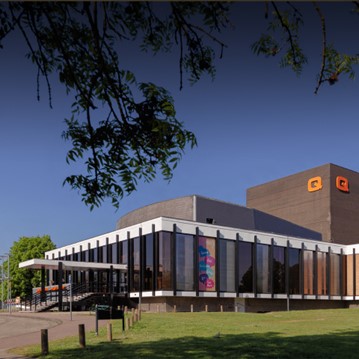
Figure 2 The Queens Theatre Hornchurch
Locally, Havering is facing severe financial problems, and there is a real possibility of bankruptcy, with a Section 114 Notice potentially being issued in the next few months. [3] This will mean that they will not be able to make new spending commitments. (17) Realistically, if we want to protect the arts and cultural organisations that already exist in Havering, more concerted efforts will need to be made to fight to protect current and future investment.
In better news, there are signs of positive steps forward to this effect, including the recent bid for Havering to be a London Borough of Culture for 2025. The bid aimed to bring in millions of pounds of investment and was put together by a collaboration of organisations under the umbrella of Havering London (made up of Havering Changing, FUSE – a local cultural education partnership, Communicating Havering, Creative Health Havering, and Havering Council) whose vision is to transform us into a hub of creative innovation. (18)
Regardless of the outcome of the bid, it matters that there is a collective enterprise fighting locally for arts and culture, championing its importance for the community.
If not now, when?
The economic picture is bleak. Local councils face extremely difficult choices. It can feel almost impossible to talk about issues like arts investment in these circumstances. But, if not now, when? The cost is too high if we do not defend our cultural institutions when they are at their most vulnerable. Now is exactly the right time to ask questions of our politicians and leaders, when the threat to the arts is higher than ever before. It is now, we need to start asking ourselves what we value as a society. We will need to take an unflinching look at what it will cost us all if we do not protect and fight for what makes our lives so worth living in the first place. Because if the arts can do anything at all, it teaches us not just what it means to live but how to come alive.
This marks the start of a series of articles that will explore the importance of arts and culture in Havering, examining what they mean for the local area as we mitigate budget cuts, and prepare for a national election.
Originally from Havering, Claire Blakemore is a freelance writer with over ten years’ experience in the communications industry. Having graduated with an MA in Creative Writing from Birkbeck in 2022, she has a particular interest in working class representation in storytelling and literature and is currently writing a series of essays about widening arts participation in the UK.
I was so proud to be elected a Labour Councillor for Romford in 2022. It has been a great pleasure getting to know local residents in St Albans Ward and in wards in Romford.
One of the most important annual duties that a Councillor in administration, like me, is required to do is set a “balanced budget”. A balanced budget essentially means that the money we have coming in covers our outgoings and debts. Unlike the NHS we are not allowed to set a negative budget. Every year this is a challenge as grants from central government have been cut.
Despite the Government cuts, Havering Council provides relatively cheap and reliable services. Officially we are a well run Council. We have the lowest unit costs of the outer London Boroughs. We are in the top quartile across London for collecting our Council Tax and Business Rates.
This week our Council has been in the news. The Leader has signalled that the Section 151 Officer may have to serve a section 114 notice.
Here are some more details that help explain why our Council, like many other Councils, is in trouble.
Government Grant
We have had over a decade of underfunding from Central Government. We receive the third lowest central government grant in London. Over 80% of our income comes from Council Tax.
People
We are required to provide some services by law. Over 70% of our budget is spent on Adults and Children’s Social Care and support to homeless individuals and families.
Funding Formula
The funding formula used by Central Government has not changed since 2013 and uses census data from 2011. And yet, Havering has seen the 4th biggest percentage increase in 0-7 years nationally. Our funding has not kept pace with our population.
Talking to Government
For three consecutive years officers have been talking to the Government Department (Department of Levelling Up, Housing and Communities also known as DLUHC) about our funding challenges and the inequalities of our funding formula.
Cost of Living and Inflation
The Council has been impacted by central government policy and changes such as the housing benefit cap and fair cost of care in adult social care which alongside the cost of living crisis has impacted our costs.
Housing
The local Housing Allowance has not kept pace with market rents in Havering. This has meant an unprecedented number of homelessness approaches and having insufficient homes to place people in, meaning we are using hotel accommodation which is expensive and falls on Council Tax payers.
Broken Markets
The market in children’s social care is broken. Residential placements keep vulnerable children safe. The competition and market’s authority published a report on this last year but typically there has been no action from Government. Placements for children can cost tens of thousands per week.
Building Regulations
Policy changes on building regulations and high inflation meant that we had to pause building affordable homes.
Havering has the second lowest level of reserves in London and our forecast budget gap exceeds our level of reserves which is why our Section 151 Officer has said we are 6 to 12 months away from issuing a section 114 notice if we do not receive additional financial support.
As you can see this a Perfect Storm.
Councillors in administration have said they will do all they can do to protect essential services and keep the Commissioners away.
This means tight controls on non essential spending.
One of the first things to be dropped in my ward is the replanting of the beds in Wheatsheaf Road. I will do what I can to work with other volunteers to get this replanted for the spring. But there will be other decisions that your councillors will have to take that cannot be fixed.
Please write to your local MP, as I will be, to ask them to fix Local Government funding. Only national government can fix this.
Jane Keane is a Havering Labour Councillor for St Albans ward
I can’t claim to have invented the above headline. That is a saying from my ward colleague, Phil, from Village Ward Dagenham. The language used around housing by the government and media can be confusing and often misleading. We need to reclaim and redefine the terms we use so it is clear what people need, versus what is really being offered.
I attended the Labour Party Conference this year in Liverpool. Andy Burnham, who I am a huge fan of, was discussing the “Levelling up Agenda”. Once again, within that conversation, the topic of “affordable rents” was raised. As I stated to the New Statesman at the time, if we are truly serious about levelling up, we need to take the term “affordable housing” off of the table. Having been a Councillor for thirteen years, and Jon Cruddas MP’s office manager for longer, I have watched this term used to justify locking out working people on lower wages from ever owning their own house.
Affordable housing is defined as housing at least 20% below local market value. It sounds good in theory, but since 2013 we have gone from it costing 6.1x the average salary to buy the average house to 8.5x the average salary in 2023 – and many earn well below that £33,000 median wage. It is almost impossible to save up for a sufficient deposit and equally difficult to secure a mortgage for that amount, and these are national averages – the issue is obviously even worse in London. It means that working class people have been completely priced out of the system. The current situation is massively in favour of developers and landowners, and people in their communities are looking over their fences to new properties that they or their family members will never be able to own. I strongly believe that it doesn’t have to be like this.
Let’s take Beam Park, which boasts “affordable“ shared ownership properties – something that really isn’t affordable, as you are purchasing a part of the property and paying a monthly rent too. I had a look at the website last week: a one bedroom from £290,000 – £305,000, and a three bedroom from £510,000 – £525,000. Who can afford properties like this?! We are in a cost-of-living crisis; patterns of work are changing and job security is increasingly difficult to find for many people. I know that many in the community are working two jobs to make ends meet. I am a great believer that you should work to live and not live to work, but people are having this choice taken away from them. I passionately feel that people’s wages should be sufficient to ensure a decent standard of living.
A big part of the puzzle to solve this housing crisis and the “unaffordable affordable housing” issue is through council housing. The people that don’t want council homes built rally against them on ideological grounds and will point to issues with the right to buy scheme. I believe that a change to the legislation around council housing that prohibits right to buy purchases for a twenty-year period would be sufficient to ensure we can provide a steady stream of affordable council housing, while ultimately allowing people to live in the houses that have become their homes for their whole lives if they choose.
I also feel that, in the spirit of truly levelling up, you devolve powers on right to buy as they have in Scotland and Wales to the local authority, who can work to provide what is needed in their local community. All sales from council housing should have 100% of the sale goes back to the council with a commitment that the money is spent to build new council homes. Finally, I believe that the right to buy discount should be maximised to 50% and capped at a maximum of £100,000, which would ensure that more council homes remain in public ownership.
The planning system in the country needs changing, and the Labour Party have said that if they win the next General Election, they intend to help first-time buyers onto the housing ladder and build more homes by reforming planning rules. What should this reform look like?
I have sat on a planning committee and have seen developers put forward their plans containing very little truly affordable housing. It’s very difficult under the current planning laws to question or reject plans to create more large and luxury homes when there is a serious deficit of rent controlled available council housing.
I watched a political programme a few weeks back and a journalist that represents young people made an alarming but not inaccurate claim. He said that the current political system provides nothing for young people in terms of housing that they can access. His take on the matter was that older voters vote in greater numbers, so the political class doesn’t worry about the offer for young people.
The rental sector also needs our attention. The high rent rates, the low quality of rental properties and rogue landlords who fail to carry out essential maintenance are all in urgent need of solutions. I believe that all people, whether renting privately, living in council housing or buying a property have a right to a decent home. We as a country have gone through austerity initiated by the Tories and the Liberal Democrats, then we all went through Covid which deeply impacted communities around the country. Now we face wage stagnation as inflation continues to outstrip wage rises, which has led to a cost-of-living crisis that has pushed many families into poverty. The trade union movement is finally starting to gain some traction and secure reasonable pay for some workers, but many still struggle and their pleas for a fair wage fall on deaf ears.
In my years as a Councillor and office manager for Jon, I have had many in-depth discussions with council officers regarding the need for more council housing. I believe that one group turning against another is counterproductive to the housing revolution that is needed for this country at this time. I feel that class politics offers a better prism through which to view the need for council housing. The task of moving forward on housing falls to unelected individuals in various government agencies, often without the necessary attachment to any given area to really fight for its best interests. The “social housing offer” is supplied with a box ticked that it has been offered, but the waiting times are enormous and only reform will bring us closer to my goal of social housing available to all who need it.
As the prospective Parliamentary candidate for Dagenham and Rainham, I will be placing council housing at the centre place of my agenda, if successful going forward. The current housing conditions that some people are forced to live in within Dagenham and Rainham are plainly not acceptable. I feel we have taken many steps backwards in how the people of our country are housed. We need Labour politicians to make the case loudly and strongly for council housing. If the Becontree Estate was possible after World War II, think of what should be possible now. The cases I deal with would break people’s hearts to hear, but it doesn’t have to be like this.
Not everyone suffers directly from poor housing, but I’ve heard from friends, parents, grandparents and children all concerned about the costs and conditions their loved ones are dealing with. I do believe that the electorate understands this and will support us in saying goodbye to “unaffordable affordable housing” and building more social housing for the many in our community, and our country, who are in desperate need.
Margaret Mullane is Village Ward Barking and Dagenham Councillor and Labour Prospective Parliamentary Candidate for Dagenham and Rainham



 Havering Fabian Society